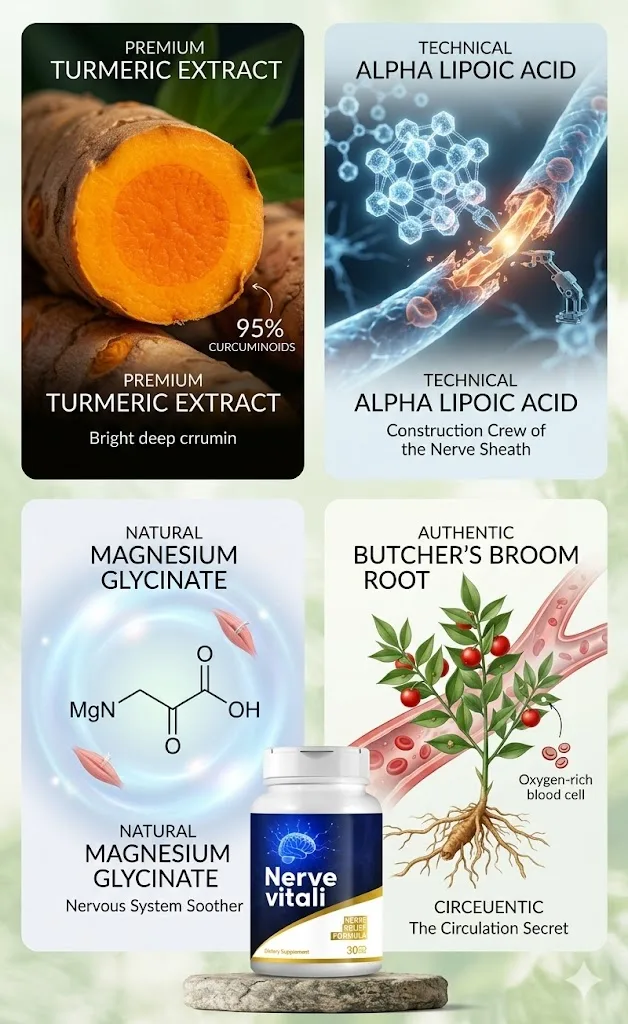
Complete Ingredient Breakdown
What each ingredient does for your nerves, and why we included it.
🔥 Turmeric Extract (Standardized to 95% Curcuminoids)
Role: Inflammation Reduction Around Nerve Fibers
When nerves are damaged, the surrounding tissue becomes chronically inflamed. This inflammation irritates already-sensitive nerve endings, amplifying the burning sensations and sharp pains characteristic of peripheral neuropathy. Curcumin — the active compound in turmeric — is one of the most extensively researched natural anti-inflammatory agents in the world, with over 5,000 published studies examining its effects.
We use a concentrated extract standardized to 95% curcuminoids — roughly 30 times more potent than the turmeric powder in your kitchen. This concentration is what clinical research actually uses. Anything less is window dressing.
Research: National Center for Complementary and Integrative Health (NCCIH)
⚡ Alpha Lipoic Acid
Role: Myelin Sheath Protection & Antioxidant Defense
Alpha lipoic acid holds a unique position in nerve health research. It's one of the only antioxidants that dissolves in both water and fat — meaning it can penetrate every layer of nerve tissue, reaching cells that other antioxidants miss entirely.
European researchers have studied ALA specifically for peripheral neuropathy for decades. It's prescribed as a standard neuropathy intervention in Germany. Research consistently points to improvements in nerve conduction speed, reduced burning feet symptoms, and decreased tingling in the extremities. ALA also helps protect the myelin sheath — the protective coating around nerve fibers — from further degradation.
Research: Linus Pauling Institute, Oregon State University
🧬 Magnesium Glycinate (80mg)
Role: Nerve Signal Regulation & Muscle Relaxation
Damaged nerves often become hyperexcitable — firing pain, tingling, and cramping signals even when there's no real threat. Magnesium functions as a natural brake pedal, regulating the calcium channels that control nerve excitability. This is why magnesium deficiency frequently manifests as nerve pain, nighttime cramps, restless legs, and persistent tingling.
We specifically chose the glycinate form because it's dramatically more absorbable than the magnesium oxide found in most drugstore supplements. Your body actually uses what you take — and it won't cause the digestive issues that cheaper forms are known for. National dietary surveys indicate nearly half of Americans consume inadequate magnesium.
Research: NIH Office of Dietary Supplements
🔋 L-Carnitine
Role: Nerve Cell Energy & Regeneration Support
Damaged nerves are energy-starved nerves. They're desperately trying to repair themselves but lack the cellular fuel to get the job done. L-Carnitine solves this by transporting fatty acids directly into nerve cell mitochondria — the energy factories inside every cell — where they're converted into usable power.
With adequate energy, nerve cells can repair membrane damage, rebuild connections, and restore signal transmission. Multiple clinical studies have explored acetyl-L-Carnitine specifically for its role in promoting nerve regeneration and reducing neuropathy-related pain scores in patients with peripheral nerve damage.
Research: NIH Office of Dietary Supplements
🩸 Butcher's Broom Root Extract
Role: Blood Circulation to Hands, Feet & Legs
Your peripheral nerves depend entirely on blood flow for survival. When circulation fails, numbness and tingling set in — starting at your toes and fingertips. The tiny capillaries feeding nerve endings in your fingers, toes, and feet deliver the oxygen and nutrients that keep nerve tissue alive. When circulation falters — as it naturally does with age — these distant nerve endings are the first to suffer. That's why tingling hands, burning feet, and numb toes are the hallmark symptoms of neuropathy.
Butcher's Broom has been used in European botanical medicine for centuries to strengthen blood vessel walls and drive blood flow to the extremities. The European Medicines Agency has formally documented its traditional use for circulatory support.
Research: European Medicines Agency (EMA)
🛡️ Coenzyme Q10
Role: Antioxidant Protection for Healing Nerve Cells
Nerve repair is a delicate process. As your body rebuilds damaged nerve fibers, those newly formed cells are extremely vulnerable to free radical attack. CoQ10 acts as a molecular bodyguard — neutralizing free radicals before they can damage the fresh nerve tissue your body just worked hard to create.
Here's the challenge: your body's natural CoQ10 production peaks around age 20 and declines steadily from there. By the time peripheral neuropathy typically develops (ages 50-70), you may have 30-50% less CoQ10 than your nerves need. Supplementation restores what time has taken away.
Research: National Center for Complementary and Integrative Health (NCCIH)